Race for AI Could Trigger Hindenburg-Style Disaster: Expert Warning
bigsansar | Feb. 18, 2026
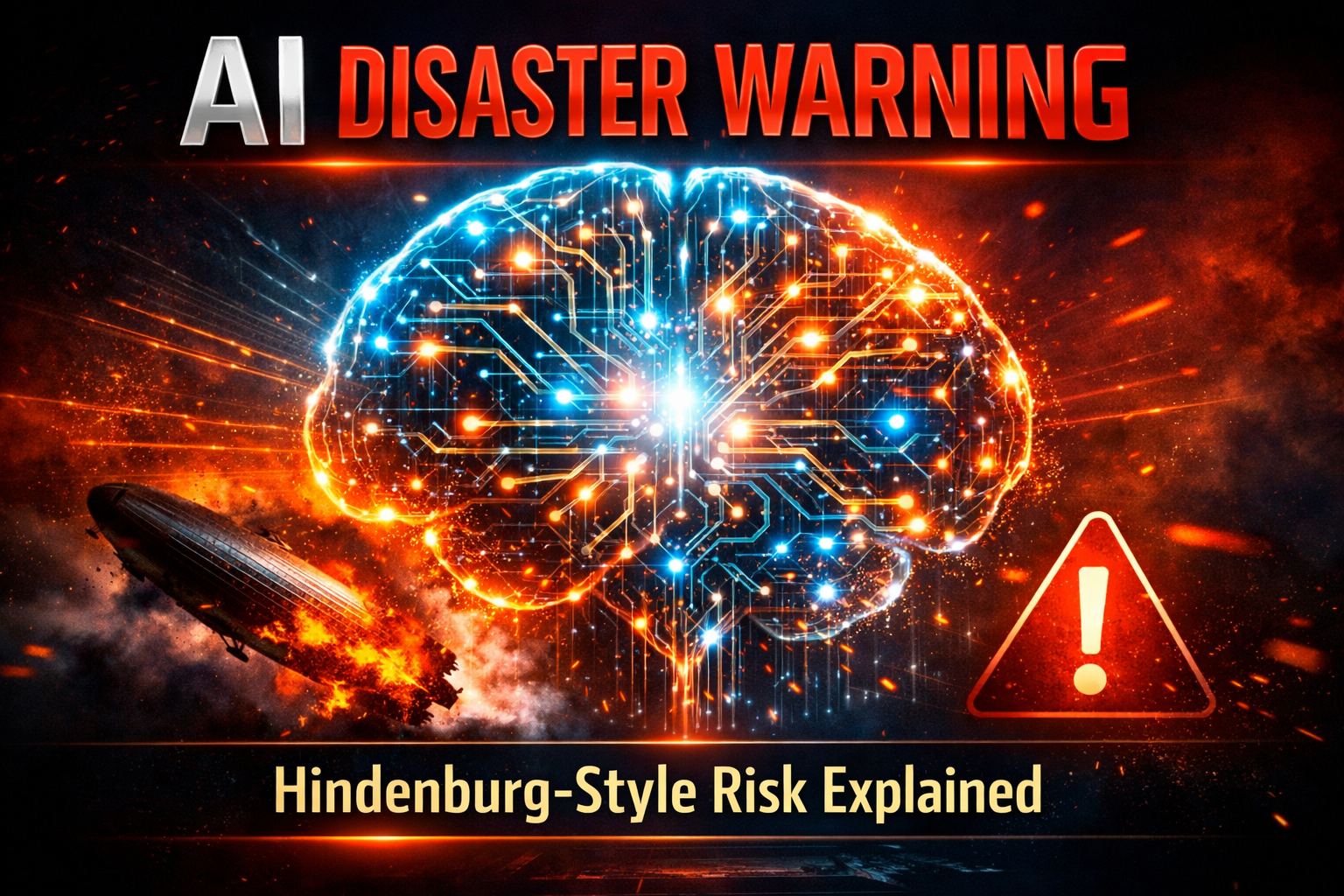
Artificial Intelligence (AI) is no longer just a technology—it is reshaping every aspect of our lives. From education and healthcare to business, security, and communication, AI is everywhere. But with its rapid development comes a serious concern: the global AI race may be creating conditions for a major catastrophe.
Recently, Oxford University’s leading AI expert, Professor Michael Wooldridge, issued a stark warning. According to him, the current AI race is so intense that it has turned the risk of a “Hindenburg-style disaster”—a large-scale public failure—into a real possibility.
What does “Hindenburg-style disaster” mean?
The Hindenburg disaster of 1937 involved a massive airship catching fire and crashing in the United States, killing 36 people. The event not only caused loss of life but also destroyed global confidence in the technology.
In the context of AI, Professor Wooldridge warns that a major failure of a powerful AI system could similarly undermine public trust, cause economic and social disruption, and set AI development back years.
Why is the AI race so intense?
AI is now not only a technology but also a tool for economic power, political influence, data control, business competition, and national security.
Major companies and startups are competing to:
- Develop the most powerful AI models
- Deploy them faster than competitors
- Gain market share and consumer attention
The problem is that speed is prioritized over safety, testing, and responsibility, which increases the risk of a serious AI failure.
AI is not perfect—yet it is already in use in critical areas
Professor Wooldridge emphasizes that today’s AI systems:
- Are not fully reliable
- Can provide confident but incorrect answers
- Operate based on predictions, not truth
- Mimic human behavior, but do not truly understand context
Despite these limitations, AI is already deployed in healthcare, banking, education, law enforcement, cybersecurity, and administrative decision-making. Any major mistake in these areas could have severe consequences.
Examples of potential AI failures
A “Hindenburg moment” in AI refers to an event that shocks the world due to a major AI failure:
1. Misinformation at scale
AI-generated fake news, videos, or audio could manipulate elections, markets, or public opinion.
2. Security system failures
AI-based cybersecurity tools failing could lead to data breaches, financial fraud, or compromised government systems.
3. Health-related errors
Incorrect AI diagnosis or treatment suggestions could endanger human lives.
4. Autonomous system accidents
Errors in self-driving cars or AI-controlled machinery could cause major accidents.
The main problem: the race compromises safety
The current mindset in AI development is:
“If we do not deploy first, our competitor will.”
This mindset encourages companies to:
- Release systems with minimal testing
- Deploy incomplete models
- Downplay AI safety
- Hide system limitations
As a result, the risk of a large-scale AI disaster is rising.
AI regulation is lagging behind development.
AI is advancing faster than governments and international bodies can regulate. Most countries still lack:
- Strong accountability laws for AI
- Clear rules for AI-generated content labeling
- Mandatory independent audits
- Structures to prevent bias or discrimination in AI
Without these safeguards, the public effectively becomes test subjects.
Can the risk be reduced?
Experts agree that AI development cannot stop, but it must be conducted responsibly.
Key steps to mitigate risks:
- Mandatory safety testing for large AI models
- Independent audits and external reviews
- Clear labeling of AI-generated content
- Human oversight of critical AI systems
- International coordination and regulation
Safety and transparency must be treated as competitive advantages, not obstacles.
AI is one of the most powerful technologies of our time, capable of enhancing education, healthcare, productivity, and scientific discovery.
However, without careful control, it could cause a catastrophic failure comparable to the Hindenburg disaster, undermining public trust and global stability.
Professor Wooldridge’s warning is clear: the AI race must prioritize safety and responsibility. The future of AI depends on whether humanity can balance rapid innovation with careful oversight.
0 COMMENTS:

NVIDIA DGX Station for Windows Brings Trillion-Parameter AI to the Desktop
NVIDIA has introduced DGX Station for Windows, a powerful AI workstation capable of running trillio…

Cybersecurity Tips to Stay Safe Online | Digital Safety Guide
Learn essential cybersecurity tips to protect your accounts, personal data, and privacy online. Sta…
OpenClaw: Nvidia’s Next ChatGPT & AI Future | NemoClaw
Nvidia CEO Jensen Huang calls OpenClaw the next ChatGPT. Discover NemoClaw and how autonomous AI ag…
NVIDIA DLSS 5 Explained: Realistic Lighting & RTX 50-Series Performance
Discover NVIDIA DLSS 5: AI-powered upscaling and improved ray tracing for RTX 50-Series GPUs. Learn…

Crimson Desert Editions Explained: What Comes in Each Edition?
Discover what comes in each Crimson Desert edition. Compare Standard, Deluxe, and Collector’s Editi…

iOS 26.4 Beta 1 Features: Stolen Device Protection Default for All iPhones
Discover the latest iOS 26.4 beta 1 features. Reports suggest Apple may enable Stolen Device Protec…

Google Pixel 10a First Look: Leaks, Expected Specs, Price & Release Date
Get your first look at the new Google Pixel 10a. Explore the latest leaks, expected specs, camera u…

How to Report Phishing: A Comprehensive Guide to Stay Safe Online
Learn what phishing is and how to report phishing scams. This complete guide explains phishing sign…
Race for AI Could Trigger Hindenburg-Style Disaster: Expert Warning
Leading AI expert warns that the global race for artificial intelligence could create a Hindenburg-…

Essential Cybersecurity Tips for All Gadget Users – Protect Your Data
Learn the top cybersecurity tips for smartphones, laptops, tablets, and smart devices. Protect your…