Python Class and Object Explained | OOP Concepts in Python for Beginners
bigsansar | March 30, 2026
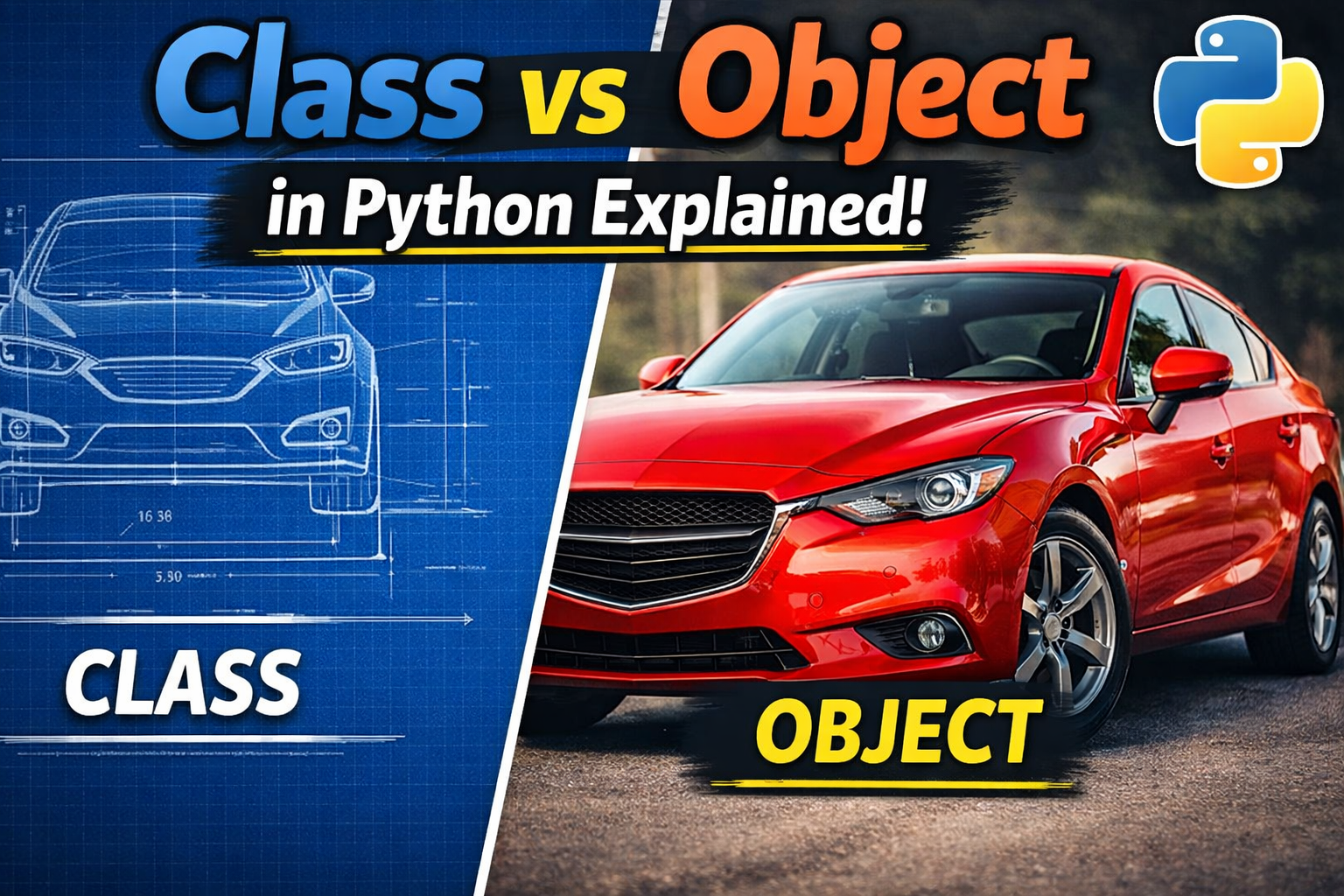
Python is one of the most widely used programming languages today. It supports Object-Oriented Programming (OOP), which is a programming style based on real-world concepts. The most fundamental concepts in OOP are Class and Object.
Understanding these two concepts is essential because they form the foundation of advanced Python topics such as inheritance, polymorphism, and encapsulation.
What is a Class?
A class is a blueprint or template for creating objects.
It defines:
- The data (attributes) an object will contain
- The behavior (methods/functions) an object will perform
In simple terms, a class is not a real object. It is only a design or plan.
For example, a house blueprint shows how a house should be built, but it is not a real house. Similarly, a class defines a structure but does not store real data by itself.
Important Point:
A class is only a blueprint, not a real entity.
What is an Object?
An object is a real instance of a class.
When a class is used to create something, the created item is called an object. It occupies memory and contains actual values.
For example, if a class is a mobile phone design, then real phones like Samsung or iPhone are objects.
Important Point:
An object is a real entity created from a class and uses memory.
Constructor (init)
The __init__() method is a special function called a constructor.
Important Point:
It runs automatically when an object is created.
Its main purpose is to initialize values inside the object.
The self Keyword
The self keyword refers to the current object.
Important Point:
It allows access to the object's attributes and methods inside the class.
Without self, Python cannot distinguish between different objects.
Real-Life Analogy
| Concept | Real-Life Example |
|---|---|
| Class | Mobile phone design |
| Object | Actual mobile phones (Samsung, iPhone, etc.) |
Practical Example (Student System)
Below is a simple real-world example to understand classes and objects clearly:
class Student:
    def __init__(self, name, age, grade):
        self.name = name
        self.age = age
        self.grade = grade

    def show_details(self):
        print("Student Name:", self.name)
        print("Age:", self.age)
        print("Grade:", self.grade)
        print("--------------------")

student1 = Student("Ram", 20, "A")
student2 = Student("Sita", 21, "B")
student3 = Student("Aarav", 19, "A+")

student1.show_details()
student2.show_details()
student3.show_details()
Output
Student Name: Ram
Age: 20
Grade: A
--------------------
Student Name: Sita
Age: 21
Grade: B
--------------------
Student Name: Aarav
Age: 19
Grade: A+
--------------------
Why are Class and Object Important?
Class and Object are the foundation of Object-Oriented Programming.
Key Benefits:
- Code becomes organized and structured
- Code can be reused easily
- Real-world systems can be modeled effectively
- Large applications become easier to manage
- Reduces repetition of code
Common Misconceptions (Fact Check)
- A class is not a real object; it is only a blueprint
- An object is not just a variable; it represents real data in memory
- The
__init__()method is not called manually; it runs automatically when an object is created
Classes and objects are the core building blocks of Python Object-Oriented Programming. A class defines structure, while an object brings that structure to life with real data.
Once you understand this concept clearly, it becomes much easier to learn advanced programming concepts and build real-world applications.
1 COMMENTS:
If you have any problem, comment on us
Python to EXE using PyInstaller + Installer with Desktop Shortcut (Kivy Guide)
Learn how to convert a Python (Kivy/KivyMD) app into a standalone EXE using PyInstaller and create …
Python Class and Object Explained | OOP Concepts in Python for Beginners
Learn Python Class and Object in simple terms with real-life examples. Understand OOP concepts like…
Create Command Line Utility in Python | Beginner CLI Tutorial (Argparse & Sys.argv)
Learn how to create a Command Line Utility in Python step-by-step. This beginner-friendly guide exp…
Argparse Subparsers Python Guide – Create CLI Subcommands with Examples
Learn how to create subcommands in Python using argparse subparsers. This complete guide covers con…
Python Packaging Explained: setup.py vs pyproject.toml (Modern Guide 2026)
Learn Python packaging from setup.py to modern pyproject.toml. Understand differences, best practic…
Build a Web Framework in Python from Scratch | Complete Guide
Learn how to build a web framework in Python from scratch using WSGI. Understand routing, request h…